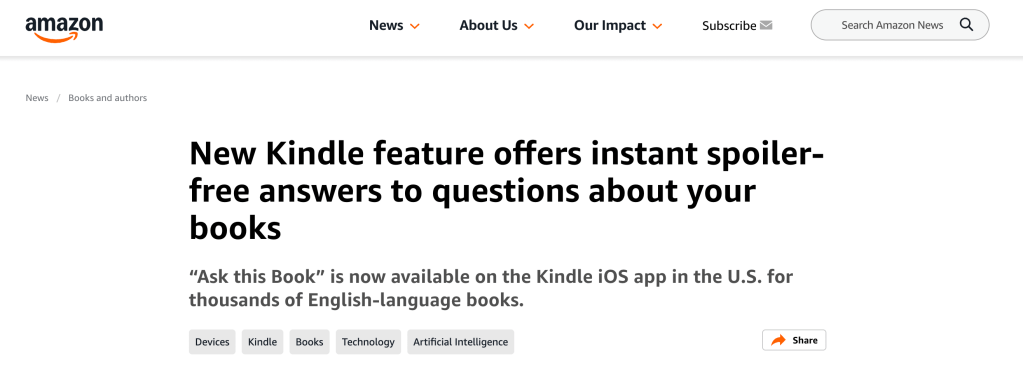
Last week, Amazon announced a new feature on its Kindle: “Ask This Book.” I have written my Representative seeking assistance in FINALLY passing legislation that protects creatives from the exploitative ecosystem of Artificial Intelligence. This is my letter, which anyone is free to adapt to their own use:
Dear Rep. Carson,
I am an attorney, bioethicist, university professor, and author, and I am deeply concerned about the continued AI-free-for-all in creative domains such as creative writing (whether fiction or non-fiction), music composition, and art.
Most recently, last week, Amazon Kindle launched a new iOS app called “Ask This Book.” This feature allows readers to ask questions about a book downloaded onto a Kindle device and receive “spoiler-free answers.” The app operates through use of Artificial Intelligence that scrapes from any work downloaded to a Kindle device, and specifically leverages a Retrieval-Augmented Generation system to deliver information about characters, world building, and plot. The app further suggests questions to readers, which undoubtedly then funnel readers through a specific engagement or interaction with a text that may or may not be in harmony with the intention of the author. Obviously, hallucinations in the responses are also a potential and continuing problem with this kind of technology.
Moreover, Amazon confirmed that permission has not been sought from either authors or publishers for the deployment of this app with respect to their works, nor can authors or publishers opt-out of the app. Authors and publishers have also not been consulted in approving or crafting the responses generated by the app either to ensure accuracy or to provide guardrails on what an author themself might consider a “spoiler” to the extent that diverges from Amazon’s determination.
The unregulated development and deployment of this kind of technology is a threat to everything from U.S. literacy rates (as students undoubtedly use the feature to circumvent actually reading and engaging with an assigned text), to misuse (either intentional or accidental) of the technology to misinform about controversial or complex texts (e.g. George Orwell’s 1984, or Derrick Bell’s Faces at the Bottom of the Well).
Beyond this though, is Amazon’s creation of a database through Kindle-scraping, that allows it to “own” an enormous dataset for purposes of training AI/LLMs without permission of or compensation to authors or publishers. These datasets may then be used/sold secondarily for unspecified purposes, ostensible avoiding the copyright issues raised by—most notably—the recent settlement by Anthropic, which was alleged to have scraped from pirated creative content to train its LLM.
As you know, Amazon controls an enormous share of the book-buying and book-reading market, including about 67% of the ebook market, selling an estimated 500 million ebooks in 2025, alone. Amazon’s dominance in the book market makes it impracticable for authors/publishers to opt-out of Amazon altogether. This is exacerbated for self-published authors like myself who lack the collective voice that publishing houses might have. As a result, self-published authors/artists began several years ago to include limitation-on-use language in their works to prohibit AI scraping/training. Traditionally published authors have recently begun to follow suit.
However, at present, there is no legislation that requires AI developers to seek permission or allow authors/publishing houses to opt-out of the use of their works in training AI, or the kind of dovetailed AI app evidenced by Amazon’s “Ask This Book” feature. No guidance or regulation exists clarifying whether such limitations-on-use are valid or enforceable, and Amazon’s “Ask This Book” app certainly proceeds on the assumption that they are not—or perhaps just that authors like myself lack the resources to enforce them against an entity like Amazon.
Additionally, a long history of inadequate regulation of BigTech like Amazon has created an ecosystem in which artists and authors must use these outlets in order to access a legitimate market for their work, despite the absence of protections against exploitation. The AI landscape that has evolved over the past five-or-so years, reveals exactly how exploitative this environment is.
While I see enormous promise in Artificial Intelligence in many industries, such as health care, I remain concerned that its use in spaces that involve centrally human endeavors, such as the creation of art, is an existential threat to our collective human culture. At the very least, it is an exploitation of creative people and a continued transfer of wealth from a demographic that has historically been paid in pennies, to a class that counts their wealth in super-yachts.
It is long past time for Congress to pass legislation that protects artists, authors and publishers from this kind of exploitative behavior and, as one of your constituents, I ask for your assistance in doing so.
I am happy to discuss this matter further and would be grateful to assist in this long-over-due work in any way that may be helpful.
Very truly yours,
Jane A. Hartsock
 Hartsock books
Leave a comment