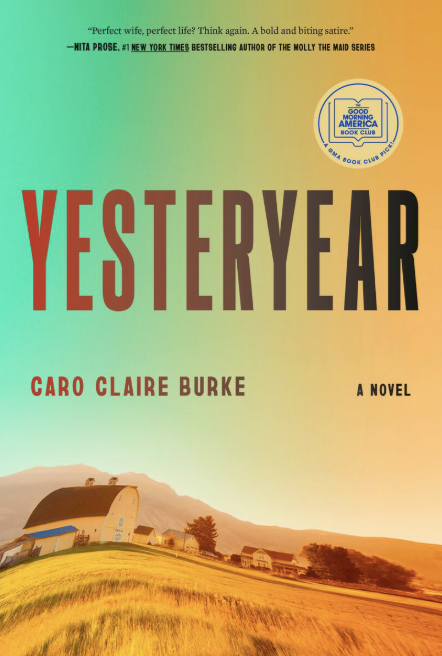
I want to begin by saying I am fully aware of the dangers (hubris?) of writing about a book that almost everyone is reading or has read, and plenty of people have already weighed in both on social media and in very long legacy media reviews, op/eds/columns/comments sections. Fortunately, my website has one subscriber and about thirty views a month, half of which are me, visiting the page, scolding myself for not posting more often, and then closing the page.
So, given that I can’t make my brain be quiet about this book, and I’m not seeing anyone really tackle what I’m calling the “menopause moment” in Yesteryear, I’m going to brain-dump some thoughts here.
Before I do that, I do just want to warn the random reader that this post proceeds as if you’ve read the book. There are multiple twists in Yesteryear, including the ending itself, which answers the whole What is going on with Natalie? question that I’m going to discuss below. If you are planning to read this book and don’t want to know the ending, you should close this now and come back to it later.
To be clear: I am going to reveal the ending below in order to discuss it. So only two people should scroll past this:
- Those who have already read the book.
- Those who have no intention of reading the book but are curious about the discourse around it.
Here we go.
Yesteryear is structured along two timelines that immediately disorient the reader. The first timeline is the Past, which to the reader seems to be present day. The second timeline is the Present, which feels very much like the past—1855, specifically. So, one of the questions the reader is immediately presented with is: How can “1855” be the Present if it’s in the past, and how can the present be the Past if it’s “today”?
The reveal/twist is that the Present is actually not 1855; it’s about fifteen years or so into the future. So the timeline might be better understood as a woman fifteen years from now, having flashbacks to her past, our present.
This ending has divided readers (as have any number of other aspects of this novel) into those who felt cheated, or perhaps more generously dissatisfied, by the ending (She’s just crazy? That’s the twist???) and those who liked the ending and thought it worked for the book. I fall into the latter camp, but I interpreted the ending, I think, somewhat differently from, well certainly some other readers, but also, it seems, critics and reviewers.
What is the “menopause moment” in Yesteryear?
In order to accept the ending of Yesteryear, the reader has to accept that Natalie (the protagonist) has had some kind of psychotic break. Several different traumas offer themselves up to various possible diagnoses. Natalie is sexually assaulted in college, and this appears to be a moment in which she loses the illusion that her childhood reality—the rules of the world as she’s been told they exist—can be operationalized in “the real world.” The second seems to be the birth of her children, particularly her oldest child Clemintine, and this has led some to speculate that her break is Post-Partum Psychosis. Then of course, her husband’s infidelity is the moment in the novel when she most visibly “snaps”, violently assaulting her content producer. And finally, there’s the final episode in the Past during which she is confronted with the crumbling façade of her social media illusion/persona, and the curtain is pulled back, so to speak, on the Instagram image she’s built and cultivated and, most importantly, monetized. I’ve also heard suggestions that the stress of her incredibly unfulfilling, disappointing marriage, and the pressure on her to make something of her do-nothing husband for the sake of his family, is too much pressure for this one woman.
And, of course, unresolved trauma is cumulative, so it’s reasonable to simply say: IT’S ALL OF IT! IT’S EVERYTHING!!
The author has not, to my knowledge, weighed in on what the right answer is, focusing instead on the larger cultural critiques in the novel. And, to be sure, one answer might be: Nothing is going on with Natalie. She doesn’t actually exist. She’s a fictional character. Make of her what you will, Reader.
But that’s no fun, so on we go.
The complication to many of the theories articulated above is trying to identify the point at which Natalie’s behavior stops being volitional, because that would be the moment we as readers could identify a “psychotic break.” I take a pause here to say that there is an entire conversation to be had about whether Natalie is ever acting volitionally given the constraints on women existing under patriarchy writ large and those existing in Natalie’s little corner of the patriarchy, specifically. I’m going to leave that topic for someone else to dive into. Instead, I’m going to substitute behavior that is logical, strategic, planned, ordered, sequential etc… for “volitional” and ask when does that get interrupted? That’s the psychotic break.
If those are the criteria, the break occurs at menopause—recall, Natalie “wakes up” one morning in “1855”, can recall all of her past up to the point her social media empire collapses, but does not recognize any of the people around her, and does not know where she is or how she got there. She also does not realize that any time has passed, does not know how old she is, and does not know what she’s been doing between the Past and the Present. While I am not-a-psychiatrist, that sounds a whole lot more like dissociative fugue than postpartum psychosis or a less formal, “this bitch is crazy.”
It also makes the ending much more satisfying (for me) and a much more biting critique of the artificiality of our instagrammed lives. The thing that “breaks” Natalie, is the experience many women have at or around menopause of becoming “invisible.” No one is looking at us. No one is watching anymore. No one is particularly interested in what we’re doing. No one aspires to be us. No one desires to be with us. Maybe I’m overstating it a bit for effect. But the invisibility of women after menopause has been well described by better writers than I, so I feel confident in articulating that it is a thing.
For a woman who has built her entire identity around being seen (a worldview she explicitly adopts in the novel, at first with God being the entity that is “always watching” and then with her followers, which also raises some really interesting questions about golden calves and false idols if you’re inclined to go down that road), to be invisible is an unsurvivable trauma after a life rife with the “ordinary” traumas women endure: patriarchy, sexual assault, childbirth, unsatisfying marriages, pressure from families, in-laws, EACH OTHER.
It is simply too much and she breaks.
This says something not about tradwives, per se but about all of us who participate, to greater or lesser degrees, in this identity-construction. The posts, the stories, the filters, the hashtags, the smiles, the selfies—womanhood has always been, to some extent, a performance, with some performances more convincing than others. Social media encourages this. It provides an environment where the performance is almost entirely within the control of the poster, easily manipulatable with decisions about what is shared and what is not, and ostensibly visible to at least your individual followers if you’re a “normal” and hundreds of thousands or possibly millions if you’re an influencer.
But the critique Yesteryear seems to be making—at least to me—is that we’re all influencers to some degree or another. We’re all (maybe not all; I do know people who entirely dodged Instagram or have no social media at all) guilty of creating personae that are artificial, entirely performative, inauthentic, complete or near-complete fabrications, only loosely based on our(real)selves. And then putting that online for others to see, and desire, and admire, and “like.”
However, as we approach menopause, the audience for that bullshit dwindles. For some, that’s a relief. For others, it’s a kind of death.
In the Past, in her thirties, when confronted with her ruse, Natalie doubles down on it. She is this person she’s been pretending to be. She is the Yesteryear Ranch. Instead of abandoning this identity, she crawls into its skin, inhabits it wholly. The identity she’s created for her followers (that much of her internalization in the Past suggests she knows is utter fabrication) she becomes. Fully.
In the Present, nearly fifty, people have stopped looking. Natalie has no audience. No one is watching. No one admires her. No one wants to be her. No one is buying the bullshit she’s selling. They don’t care about her house or her hair or her clothes or her bread or her children or her husband or her brand.
And the novel asks: Who is Natalie when no one is watching?
As I read the novel, Natalie has so completely abandoned who she actually is (and maybe she never knew to begin with), that she is no one. There is nothing there, just a shell and the confused memory of a sequence of performances with nothing to anchor her to the radically altered present she is entering with mid-life.
That is what Yesteryear is about: not “tradwives”, but the distortions of identity and authenticity that are augmented by social media (and probably Instagram in particular).
Who are you when no one is looking?
If this is true, that this is what Yesteryear is about, and I liked Yesteryear, which I did, very much, (5/5 stars), then I have to reconcile it with another menopause book, I did not particularly care for: All Fours. My objection to All Fours was that it relied on the crazy-woman trope in an unsophisticated and irresponsible way (I also thought the book should have been categorized as erotica, but that the publisher intentionally categorized it as psychological fiction, so that it could be marketed to “the serious reader” TM). Anyway, there, the main character Audre lacks insight, seems to learn nothing, and does not act rationally as she approaches menopause. Instead, she panics (understandably) about the looming estrogen cliff after which both sexual desire and sexual desirability just… vanish. Her solution to this is to rent a room at a seedy, highway-exit motel (a symbol if ever there was one for disvalued, illicit—if not illegal—sex), redecorate it (i.e. make it hers, inhabit its identity?), and then use it to seduce a younger man working as a mechanic across the street and a post-menopausal woman whom Audra essentializes to her physical appearance and describes in explicit and derrogatory terms. I think she calls her a “crone” among other descriptions.
So, what is the difference between these two books if both rely on the “crazy woman” trope to explore the existential crisis that is menopause?
I think All Fours doesn’t know that Audra is a/the problem in that novel and doesn’t present her as a cautionary tale of a woman who fails to learn and grow in a space where learning and growth are possible (e.g. during peri/menopause). In contrast, Yesteryear ask the reader to critique that lack of growth, that lack of insight, the flat arc, the failure to learn.
This does mean that author-intent is fundamentally important—at least to my mind—to whether Yesteryear “succeeds” as a story. If the reader is supposed to feel sympathy for the characters in Yesteryear, and for Natalie in particular, I’m hard-pressed to do so. If we are supposed to read the book narrowly as just a critique of tradwives, the book fails because tradwives may be the most visible example of performative womanhood, but they are certainly not the only example of it. If the author did not make the connection between the “final straw” for Natalie at menopause, and the cultural conversation around the experience of invisibility around menopause, the book also fails. It might be accidentally thought-provoking, but it’s not “smart.”
However, I’ve seen and read the interviews with the author of Yesteryear (some of which I’ve linked above), and I think she knew exactly what she was doing, with every beat of this story.
The book is a mirror, not a portrait, and we are not supposed to like what we see.
 Hartsock books
Leave a comment