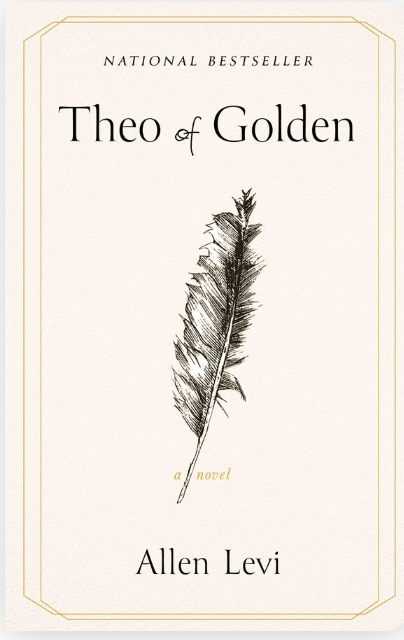
Spoilers follow:
I was told to read this book so many times, I almost didn’t read it just to be a contrarian. Finally, I saw an analysis of the language usage in the novel, sentence length and structure, and that was enough for me; I decided to give it a whirl. Specifically, the article (which I can’t find now) remarked on the complexity of language in Theo compared to so many of the other best sellers today and commented that the writing was more aesthetically pleasing, lyrical, and evocative than almost anything else presently sitting on the shelves at Target. I think I agree with this, though, I’m not sure that sets the bar very high.
In any case, I was also intrigued by the fact that this novel’s author Allen Levi (like myself) is a former attorney.
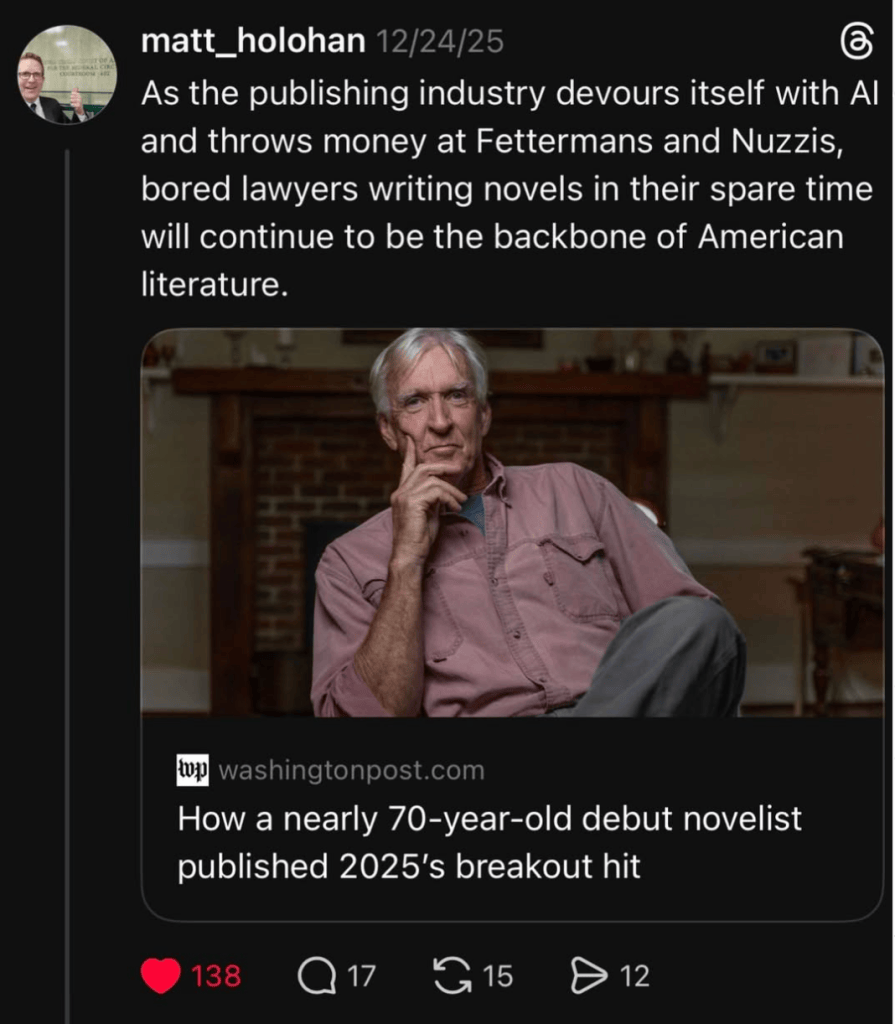
And by the fact that the author (like myself) initially self-published his novel, and has since managed to live the absolute fantasy of every self-published author I know–word of mouth recommendation, leading to break out success, leading to best-seller status, leading to movie deal (STARRING TOM HANKS ARE YOU KIDDING ME???)
I found the book initially a bit slow, which didn’t bother me; I’d been warned that was the case. I also noted that the language, as promised, was truly beautiful. The specific choice of words, a phrase, a single sentence–exquisitely written, all the more so because despite the sentence level craft, the language remains accessible. It is an aesthetic of the novel that elevates the story rather than obscuring it.
But I started to struggle fairly early on in ways that did not have to do with pacing and ultimately failed to resolve even with what most have found to be an extraordinarily moving ending.
My two big issues with the book were:
(1) A reliance on pretty retrograde character tropes, including a poor Black man who works as a janitor; an unhoused woman with mental illness; an abusive boyfriend of a preternaturally beautiful young woman; an “illegal” immigrant; and the comparison between Theo’s alcoholic dead wife (no redemption arc for her) v. the angelic one-who-got-away that guided his journey to Golden in the first place. Almost every supporting character exists along easy stereotypical lines, right down to a causal one-sentence reference to an incarcerated man who had grown up in the foster care system. I also agree with the critique of others that there is a disproportionate focus on the male characters in the novel.
(2) A refusal to adopt a consistent narrative point of view that is a frequent feature of “bad” self-published books. Specifically, the book shifts between something that resembles third-person omniscient and something that resembles third-person close (usually, but not always Theo) with near constant “head hopping” whereby a chapter or section opens in one character’s point of view (say, Asher’s) and then flops around to Theo, Tony, or whoever else happens to be in the scene.
Here, I will admit that when I returned to creative writing several years ago, my first (unpublished, will never see the light of day) novel indulged this practice, and even after my first writing group very clearly and without wavering told me “Absolutely not, you cannot do this and also head hopping is not the same thing as Third Person Omniscient, and what you are doing is head hopping and you should stop”… even after all that, I resisted for months before finally acquiescing that not a single one of the books I considered “good” treated narrative point of view the way I was.
Having read Theo, I now understand why. It is disorienting, distances the reader from Theo, frustrates questions of what is known and who knows it, and is simply confusing as it’s not clear whose “eyes” we are looking through at any particular time. If my mind wandered for even a second, there was a risk that when it returned, I would have to figure out who was seeing or thinking what as it was entirely possible, we’d have left the opening point of view and were now somewhere else entirely. This was maddening.
[I will also say that the book should be genred as Christian fiction, but is not. Authors mis-genreing their books to increase potential audience or legitimacy (both of which I suspect is the case here), absolutely infuriates me. Beyond that, as a Catholic (lapsed though I am), I found the representations of the sacred and religious imagery and symbolism to be heavy handed. A friend (also Catholic, also lapsed) texted me as he was reading it and described the book as “saccharine.” This seems right to me.
So I didn’t connect with the book and the sentence level writing wasn’t enough to save it for me.
Despite this, I think the book is important in ways that deserve to be taken seriously. Any time a book captures the public’s attention, it is worth taking a moment and asking, “What is this book giving people that they seem to want?”
When considering this question, I immediately thought of Project Hail Mary another book that was enormously popular, written by a formerly self-published author.
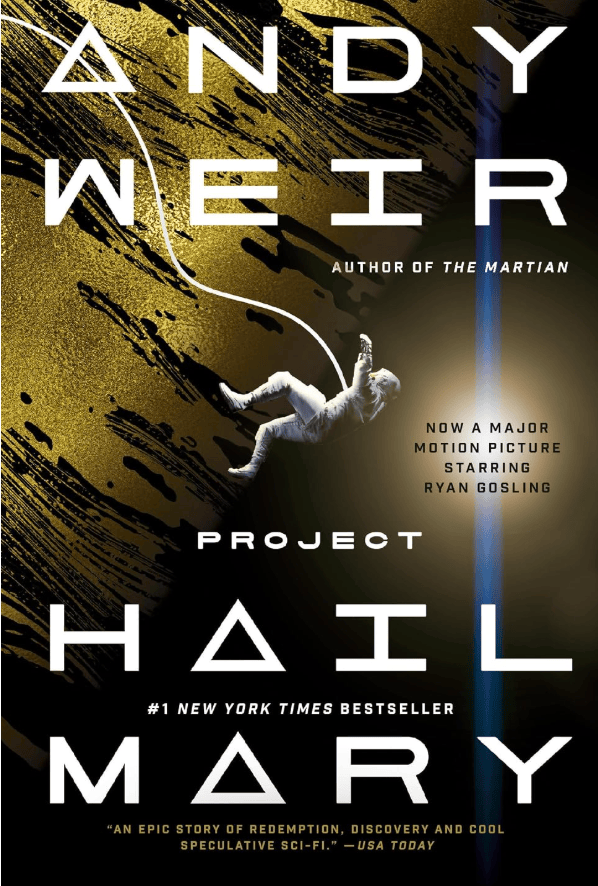
To be clear Project Hail Mary is not Christian fiction, and it is not literary fiction. But if Theo was strong writing weak story, Project Hail Mary was weak writing strong story, and I loved Project Hail Mary. I loved the book, I loved the movie. If I’m having a bad day, I put on the PHM soundtrack and just enjoy a few minutes of remembering what hope feels like.
And I think that’s the crux of it for Theo. What resonates with people about this book is that, at its core, it’s a book about kindness, about a man who has done some good things and some bad things, and in the final chapter of his life, does some very good things. The people around him love him. He loves them. He loves his children. He loves music. He loves art. He loves life. He sees the sacred in the world and pauses, acknowledging it.
What makes this book important then, is its wild popularity combined with its unconventional path to success–a path shared by Andy Weir, whose novel The Martian is another example of a self-published novel that exploded by way of word of mouth, leading to break out success, leading to best-seller status, leading to movie deal (STARRING MATT DAMON ARE YOU KIDDING ME???). And all of this points to something that writers already kind of know: publishers are quite bad at predicting what readers want to read.
There are presently five major publishing houses, and nearly all of the fiction that achieves any measure of commercial success is funneled through that gauntlet. Much of this gauntlet appears to be guided not by any particular aesthetic or desire to produce art or “literature,” but by a ruthless algorithmically based analysis of what will sell and what the profit margin on that will be, right down to calculating the cost of printing each page of a novel against the upper limit that research shows readers will pay for a hardcover (this is one reason why novels–and their sentences–have gotten so short).
If you’re inclined to say “Duh, Jane. Book selling is a business,” I have to respond… Well yes, but it’s a qualitatively different kind of business, because–like art, and music, and theatre, and dance–literature is a qualitatively different kind of “product”, one that, I would submit, is intrinsic to the human experience, and indispensable to a well-functioning democracy. Along the way to the profit margin, publishing has contributed to a flattening of literary invention. Looking to see what books are “hot,” the industry pumps out more of those, like a restraunteur who notices a popular India restaurant in town, so immediately opens twelve more just like it. Indian food is great, but maybe it would be nice to have a gyros occasionally. Confronted with fewer options, readers read less and further limit themselves and then, citing the very problem they caused, the industry cries that readers are more “discerning” than ever, and further limits what they published, which discourages reading (wash, rinse, repeat).
Self-published authors could be an alternative to this–as a Gen-Xer, I’ve viewed us almost like the early punk/alternative bands selling tapes and CDs out of the trunks of their cars, relying on dubbed tapes and word of mouth on college campuses to get around the absolute strangle-hold of music houses of the 80s and 90s. And maybe this would still be the case if it weren’t for LLMs.
Without getting into the myriad of problems with machine learning and the theft of creatives’ work (many of us self-published), the absolute deluge of slop, and the complete refusal of anyone from Congress to local counsilpersons to do anything about it, finding that small weird (probably self-published) book that might appeal to you is simply impossible. They aren’t elevated in advertising algorithms, aren’t shelved in chain bookstores or, often, even in indie stores, and finding them online is incredibly difficult as bot-slop-generators toss out titles that copy those of self-published authors but are definitely not our books. My first published novel Load Bearing has no fewer than NINE shadow novels–all published in 2026 (two years after mine) under the same title, most published outside the U.S., clearly formatted using Amazon’s free KDP software, and more than a couple appear to pull similar themes to my own novel. It’s almost like their entire purpose is to confuse readers. A brief review of these titles unsurprisingly reveals hallmarks of LLM-generation from covers to blurbs to the first couple of sample pages.
So back to Theo. This book managed to get through. It captured enough people’s attention with a message of hope, and kindness, and beauty, notwithstanding its complete failure to “play by the rules” of contemporary fiction. It is a different kind of book, and people love it. This book sits alongside, books like The Correspondent, Lessons in Chemistry, Tomorrow and Tomorrow and Tomorrow, and a whole host of other books that are absolutely beloved, and depart from the sea of similar covers, titles, and plots lining the Target bookshelves.
While I did not connect with Theo, it is enormously important that so many people did, both for the uplifting, redemptive, restorative themes of the book and for the reception it received (or initially didn’t, as the case may be) from the commercial publishing industry. The story of the book-that-almost-wasn’t is so ubiquitous at this point that it should be a come-to-Jesus (that’s a Theo pun) for the publishing industry. It won’t. But it should.
Alternatively, those of us writing self-published novels desperately need some regulation of this industry in the age of AI. Requirements to label work AI-generated and/or AI-assisted would be a great place to start. Allowing online book browsers to “filter” for human-written books, would be another. I have all the predictable opinions about scraping and copyright infringement, but as it relates simply to the impossible task of reaching an audience, Theo shows the readers are there, if authors can reach them.


Leave a comment